
Custom services
A one-off need or a project to delegate? Invite our team of engineers to your facilities. Whether you need rapid technical support, a strategic deployment plan, or to entrust the management of customized engineering mandates, our team can optimize your operations.
Why is this advantageous?
Optimize your projects with total flexibility
Our on-demand service offering, in the form of a bank of hours, is an agile solution for your engineering projects. It allows you to call upon our team whenever you need to resolve a specific problem or contribute to various automation projects. You can count on our team of experts to respond quickly and efficiently.
Integrate our expertise into your team
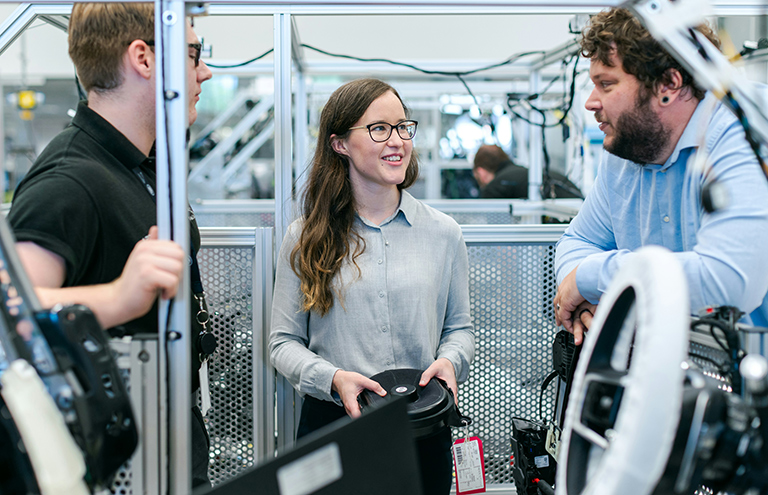
Benefit from the expertise of our engineers specializing in automation, robotics, and mechanical and electrical design. We resolve both minor and major issues on your production line by offering concrete solutions tailored to your specific needs.
Engineering services available à la carte
Technical drawings and documentation
Updating or creating technical drawings (2D/3D)
Production or upgrading of 2D/3D electrical, mechanical, pneumatic or hydraulic plans and diagrams, created in AutoCAD, SolidWorks or equivalent tools, in order to obtain an accurate, compliant and up-to-date representation of equipment and installations.
Reverse engineering of existing plans
Reconstruction of missing or incomplete technical documents from existing equipment, with conversion into accurate digital plans in AutoCAD, SolidWorks or equivalent tools.
Standardization and normalization of technical documents
Standardization of formats, symbols and conventions used in plans to ensure complete consistency and compliance with industry practices.
Converting paper plans into digital formats
Digitization of physical technical documents with faithful reproduction of information and transfer into compatible CAD formats such as AutoCAD, SolidWorks or equivalent tools.
Electrical and mechanical design
Electrical panel design
Design of power supply and control modules including component selection, internal organization, appropriate sizing and preparation of CAD plans compatible with AutoCAD, SolidWorks or equivalent tools, according to current industry standards.
Dimensioning of mechanical components
Evaluation of loads, forces, speeds and constraints applied to parts in order to establish the appropriate sizes, materials and tolerances to ensure performance, durability and compliance with operational requirements.
Integration of sensors, actuators, motors, etc.
Coherent implementation of detection and drive elements in a system, including the choice of devices, optimal positioning, wiring and functional compatibility to ensure reliable and harmonized operation of the whole.
Adjustments or corrections to existing installations
Targeted modifications to existing equipment, including component updates, operational improvements, or correction of technical errors to restore system performance, reliability, and compliance.
Verification of compliance with standards (CSA, UL, etc.)
Technical verification ensuring that the equipment and its components meet the requirements of applicable standards, with examination of the wiring, protective devices, choice of materials and assembly method to guarantee full compliance with recognized standards.
Equipment selection and technical specifications
Precise determination of required components and definition of associated operational parameters, based on performance requirements, process constraints and applicable standards, to ensure reliable and optimal integration into the system.
Machine safety
Risk analysis according to applicable standards
Structured hazard assessment of a machine or process, carried out according to the standards in force, in order to identify hazardous scenarios, estimate their level of risk and define the reduction measures necessary to achieve an acceptable level of safety.
Recommendations for security improvements
Proposal of corrective and preventive measures adapted to the identified risks, including the addition or modification of protections, detection devices or procedures, in order to achieve a level of security in accordance with standards and operational requirements.
Validation/implementation of lockout/tagout systems, security curtains, and emergency stops
Complete verification and installation of locking devices, protective light curtains and emergency stop circuits, including review of their configuration, functional reliability and compliance with regulatory and normative requirements.
Upgrade for legal compliance
Adaptation of equipment or systems to comply with current regulatory requirements, including the addition of safeguards, modification of existing devices and updating of critical elements to achieve a level of security that meets legal obligations.
Report generation and prioritization of corrective actions
Drafting structured documents presenting technical findings, risk assessment and the optimal order for implementing recommended measures, established according to the seriousness of the issues and the impact on operational safety.
Engineering calculations and analyses
Mechanical load calculations
Determination of the forces, stresses and moments applied to the parts or assemblies, allowing the required strength, the appropriate dimensioning and the structural capacity necessary to ensure performance and durability.
Technical feasibility studies
Production of preliminary analyses to assess the viability of a solution or modification, by examining mechanical, electrical, operational and regulatory constraints to determine if the project can be carried out reliably, safely and in compliance.
Optimization of existing workstations or cells
Improving the efficiency of work areas or production cells by analyzing flows, cycle times and technical constraints, in order to identify and correct sources of inefficiency to increase operational performance.
Structural inspections of equipment
Evaluation of the ability of a component or assembly to support the intended loads, by analyzing stiffness, deformations and safety margins to confirm that the structure adequately meets the mechanical service requirements.
Programming and optimization of automated systems
PLC programming (Rockwell, Siemens, Schneider, Omron, Phoenix Contact, etc.)
Development, configuration and updating of industrial PLC logic from various manufacturers, including structuring routines, integrating inputs/outputs (I/O) and adjusting sequences to ensure stable, efficient operation compatible with the existing control architecture.
Development and adjustment of HMI interfaces
Design and optimization of operator screens enabling clear, intuitive and efficient interaction with equipment, including page organization, variable integration, alarm display and adjustment of visual elements to ensure reliable and user-friendly operation of the process.
Debugging/optimizing existing routines
Correction of faulty sequences and improvement of programmed logic in PLCs, including analysis of unexpected behaviors, adjustment of timings, reduction of unnecessary cycles and optimization of performance to ensure stable and efficient operation.
Integration of new equipment into existing systems
Adding devices or modules into an existing automation architecture, including connecting to inputs/outputs (I/O), adapting communications, updating control sequences and verifying functional compatibility to ensure a stable and consistent transition with the existing process.
Program backup and documentation
Structured archiving of software versions and writing of associated technical information, including file organization, description of routines, list of variables and configuration notes, to ensure traceability, efficient maintenance and continuity of operations.
Performance diagnosis and optimization
Bottleneck analysis
Identification of points limiting the rate of a process or equipment, carried out by observing sequences, measuring cycle times and examining interactions between operations, in order to determine where performance losses are located and what targeted actions can increase overall throughput.
Detection of recurring problems (vibrations, cycle time, unstable sensors)
Systematic identification of recurring anomalies affecting performance, such as abnormal vibrations, variations in cycle time or irregular signals from sensors, in order to determine their technical causes and propose the necessary adjustments to stabilize the equipment.
Optimizing the speed/efficiency of equipment
Adjusting the mechanical, electrical or programmed parameters of a machine in order to increase its throughput, reduce downtime and improve its overall performance, while maintaining stability, repeatability and operational safety.
Mechanical alignment check
Control of the relative position of moving or fixed components to ensure that the orientation, parallelism or centering meets the tolerances necessary to avoid premature wear, excessive vibration or performance losses.
On-call emergency repairs
Rapid intervention aimed at resolving an immediate technical anomaly, including analysis of machine behavior, identification of the probable cause and application of a temporary or permanent fix to restore normal system operation.
3D scanning and technical surveys
3D scanning of industrial facilities
High-precision three-dimensional acquisition of complete industrial environments, enabling the capture of the actual geometry, volumes and positions of equipment in order to generate a faithful digital model usable for design, planning or reverse engineering.
Creation of accurate digital models
Generation of faithful three-dimensional representations from data captured in the field, enabling the obtaining of an exact geometry of the installations and the preparation of CAD environments usable for the design, modification or planning of projects.
Data for reverse engineering
Accurate collection of dimensions, positions and geometries directly from existing equipment, in order to have the information necessary to reconstruct reliable digital models used during the reproduction, modification or improvement of industrial installations.
Preparing a CAD environment for future projects
Setting up a clean and structured digital model from the captured data to provide a CAD base ready to accommodate designs, modifications or integrations in subsequent projects.
As-built/as-designed comparison
Detailed comparison between the digital model from the actual survey and the initial planned design, in order to identify discrepancies, deviations or modifications that occurred during installation and to ensure consistency between the documentation and the current state of the equipment.
Integration and occasional technical support
Emergency technical assistance
Rapid intervention aimed at diagnosing and restoring essential functionality during a critical failure or technical incident.
Field support during equipment start-up or shutdown
Operational technical assistance offered directly on site to support the start-up or shutdown phases of equipment in order to ensure a safe and efficient transition.
Validation of supplier installations
On-site assessment aimed at confirming the conformity, quality and functionality of installations carried out by suppliers.
Technical supervision of projects
Technical and documentary supervision ensuring rigorous monitoring, informed coordination and specialized interventions to guide progress, prevent deviations and guarantee the overall quality of project execution.
Targeted technical advice at the moment
Occasional technical support offered on an hourly basis to provide in-depth analysis, offer context-appropriate recommendations, resolve targeted issues and effectively support decision-making or operational optimization.
Audits
Electrical audit
Comprehensive analysis of electrical installations aimed at assessing compliance, detecting risks, verifying the quality of equipment and formulating recommendations to ensure safety, performance and reliability.
Machine safety audit
In-depth analysis of a machine’s protection systems and devices to assess regulatory compliance, identify risks associated with hazardous movements, and recommend corrective measures necessary to ensure safe operation.
Automation and performance audit
Detailed analysis of automation systems and operational processes aimed at measuring actual performance, identifying inefficiencies, assessing the robustness of controls and recommending improvements to optimize reliability, speed and overall productivity.
Layout audit (flow and ergonomics)
Comprehensive analysis of the layout, operational flows and ergonomic conditions to identify inefficiencies, optimize movement and interactions, reduce risks for workers and recommend a more efficient and safer overall layout.
Robotics Audit
Specialized analysis of robotic cells and human-robot interactions aimed at evaluating safety, operational accuracy, trajectory efficiency and overall performance, while identifying possible optimizations to increase reliability and productivity.
What is a Time Bank?
he time bank is a package of time you can use at your own pace. It’s an attractive option for companies without an in-house engineering team to optimize their operations. Use this simple and flexible way to access our expertise, whether it’s to diagnose a problem, integrate a solution, configure programmable logic controllers (PLCs), or launch a new project.
Our process
We begin by understanding your objectives, challenges, and environment. Then, based on established priorities, our engineers work on-site or remotely, as needed. Every hour is used strategically with a focus on efficiency. Our communications are clear, and we deliver measurable results.
Discover our projects
Customized BAS solution for the Affi group
Engineering at your fingertips
Benefit from flexible access to our engineers to meet your technical needs, large or small. A simple, fast, and efficient solution to move your projects forward.